

Understanding Machine Learning
Why It Matters for Project Managers

Machine learning (ML), a subset of artificial intelligence (AI), transforms various industries by enabling computers to learn from data, make predictions, and improve over time—without explicit programming (i.e. telling the computer what to do at each step).
For project managers, understanding ML isn’t just a technical skill; it’s a strategic advantage.
Let’s take a deeper look at what ML is and how you can ask the right questions when choosing an AI tool for your next project. We’ll discuss:
What is Machine Learning?
Why Project Managers should care
Which ML questions to ask to evaluate AI Tools
The Project Manager’s role in AI adoption, and
3 Actions to take right now
What Is Machine Learning?
At its core, ML is about identifying patterns in data to make predictions or decisions.
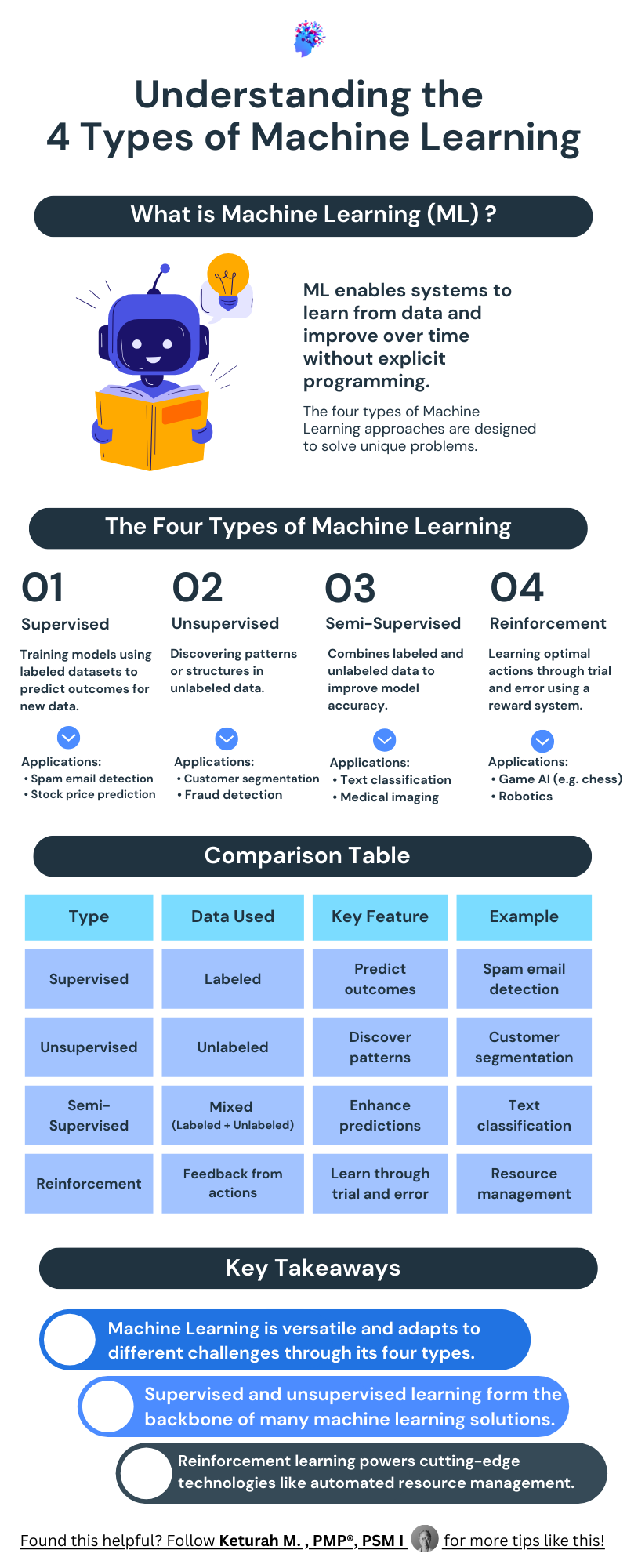
It is typically divided into four main types:
Supervised Learning: Trains on labeled data to make predictions (e.g., forecasting project timelines).
Unsupervised Learning: Finds patterns in unlabeled data (e.g., grouping similar projects for resource allocation).
Semi-Supervised Learning: Combines both labeled and unlabeled data for more robust predictions.
Reinforcement Learning: Learns through trial and error to optimize actions (e.g., AI tools suggesting best practices over time).
Central to ML's effectiveness are concepts like decision processes, error functions, and model optimization, which collectively refine accuracy and minimize errors.
While ML often requires human intervention to select features, deep learning—a subset of ML—utilizes neural networks to process unstructured data with minimal oversight, thereby enhancing automation and scalability.
However, challenges such as overfitting, data quality, and interpretability highlight the need for careful evaluation and optimization. For project managers, understanding these fundamentals not only demystifies the technology but also provides a strategic lens for assessing AI tools, enabling teams to adopt solutions that align with their goals and improve operational efficiency.

Why Should Project Managers Care About ML?
Project management is becoming more data-driven, with ML-powered tools offering insights that were previously difficult to uncover.
These tools can:
Predict project risks based on past data.
Automate time-consuming tasks like resource scheduling.
Provide actionable insights and automate reactions to team performance and task completion rates.
By understanding ML, project managers can better evaluate the capabilities of these tools and ensure they align with their team’s needs and goals.
How to Use This Knowledge to Evaluate AI Tools
When considering project management AI tools, ask critical questions grounded in ML concepts:
Data and Predictions
What data types does this tool use, and how does it generate predictions?
Can it handle the specific types of data your team generates?
Patterns and Insights
How does the tool identify patterns in data?
Does it use clustering (unsupervised learning) or classifications (supervised learning)?
Can it provide insights that are actionable and relevant for my team?
Accuracy and Optimization
How does the tool ensure accuracy in its predictions?
Does it evaluate performance against unseen data to avoid overfitting?
How often does it optimize its algorithms to stay relevant?
Adaptability and Feedback
Can the tool learn from my team’s usage (reinforcement learning)?
How does the tool recognize “rewards” or positive project outcomes based on its predictions?
Does it allow for feedback loops to improve over time?
The Project Manager’s Role in AI Adoption
Understanding ML empowers project managers to choose AI tools that deliver real value. By asking the right questions, you can ensure these tools align with your team’s needs and help you achieve your project goals efficiently.
ML is no longer a “nice-to-know” concept—it’s a must-have skill in the modern project management toolkit.
Next Steps
Familiarize yourself with the ML concepts shared here.
Use the provided infographic to solidify your understanding of ML types.
When considering AI tools for your team, approach vendor conversations with confidence and critical thinking.
The future of project management is in machine learning—are you ready for it?
-The Smart AI Project Manager
Do you have any burning questions about Machine Learning? Share them!
Want to delve deeper into how AI can transform projects? Check out all my ebooks covering the intersection of project management and AI. They’re live on Amazon now!
Don’t forget to follow me on LinkedIn for insights each week!