

Prompt Engineering vs. Model Training: The Difference and Why It Matters

If you’ve spent any time trying to “fix” an AI output, you’ve probably found yourself wondering:
Do I need a better prompt… or is the model itself the problem?
Welcome to the fork in the road that divides two powerful forces behind today’s AI: prompt engineering and model training. They’re related, but are entirely different. Understanding when to tweak a prompt versus when a model needs re-training (or fine-tuning) can help project managers and any Gen AI users avoid unnecessary wasted time.
Let’s break it down.
Prompt Engineering: Talking to the Brain That’s Already Built
Prompt engineering is the art of communicating with a pretrained model. The model has been tested and should be ready to give outputs based on stored data.
When you engineer a prompt, you’re doing something like:
Giving clearer instructions (“Summarize this in one sentence using plain language”)
Setting a role or persona (“You are a project coordinator with 2 years of experience…”)
Providing examples or structure (“Here’s a sample project update. Please generate a similar update for this task.”)
Prompt engineering is often enough when:
The model has the knowledge you need, but your prompts aren’t detailed or give enough context for the model to express itself well.
You want output in a specific format or tone.
You’re working on task-based applications (e.g., writing emails, cleaning up notes, etc.)
With prompt engineering, the model’s capable, but it’s up to you to give it the right context and direction.
Model Training: Rewiring the Brain Itself
Model training is something else altogether. It’s the process of actually changing the model’s understanding of the world, either from scratch (pretraining) or on top of existing knowledge (fine-tuning or LoRA).
Training is expensive and time-consuming. But it’s necessary when:
The model doesn’t know what you want or need it to know.
You need it to perform consistently in a specialized domain (e.g., legal, medical, EdTech, or industry-specific workflows).
You want to align behavior beyond what prompts alone can manage.
What does it take to train a model?
Massive Data: You need millions of clean, high-quality examples (text, documents, logs) tailored to what you want the model to learn.
Heavy Computing Power: Training runs on expensive, high-performance hardware (usually GPUs) and can cost thousands to millions, depending on model size.
Expert Involvement: Data scientists and ML engineers are required to fine-tune, monitor, and troubleshoot the process; it’s not a DIY task.
Ongoing Testing and Oversight: Even after training, models need extensive validation for accuracy, bias, and reliability checks in perpetuity.
So, Which Do You Need?
Think of it like this: It’s summer, and you decide your kitchen needs a refresh. You have two options: 1) Freshen up the paint, put a new counter and backsplash in, or 2) Gut the kitchen to make it structurally sound for your day-to-day life.
In the same vein:
Prompt Engineering is the fresh paint, counter, and backsplash. You style the output, guide the tone, shape the format, without changing the model’s basic structure.
Model Training is the gut job. You’re altering the actual structure of the knowledge and behavior of the model.
This example also gives a sense of the effort and cost put into these two different types of adjustments to AI. Prompt engineering is great for sprucing up and getting things to look good with a bit of elbow grease. But if the underlying structure (i.e., the AI model) is trash, no amount of prompt engineering is going to make a difference. You need a remodel.
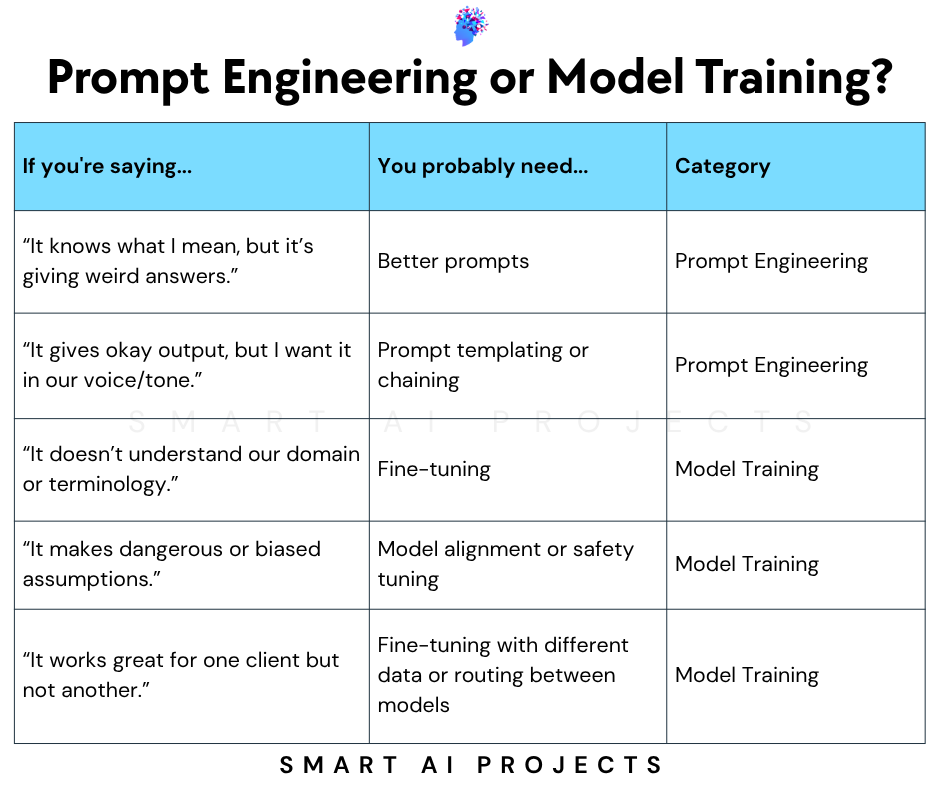
Need a visual? Here’s a helpful way to choose which is for you:
Having this knowledge in your toolbelt, how do you move forward?
Be Smart, Go Hybrid
The most powerful AI PMOs use both strategies: fine-tuning models for specialized knowledge and engineering prompts to get the right outputs. This layered and intentional approach lets you balance cost, speed, and control.
Key takeaway: Don’t spend excessive time on prompt engineering and getting poor outputs. You also have the option to ask: “Is this a prompting problem, or a model problem?”
When you know the difference, you can stop painting over warped cabinets and start building smarter, more stable solutions.
-The Smart AI Project Manager
Follow me on LinkedIn for regular AI and project management insights. This is a great place to get a conversation going, too!
If this post sparked new ideas or helped you better understand AI, I’d be grateful if you shared it with others who might benefit from it. Writing and sharing these insights takes a lot of time and research, but it’s all worth it when it reaches and helps more people. Every share helps this blog grow and keeps the conversation going. Thank you for being part of this journey!